

A Father and Daughter's Review of Pokémon Pokopia
In which Patrick and his nine-year-old daughter put on their critic hats for Nintendo's cozy new Pokémon video game that's all about, well, tasks.

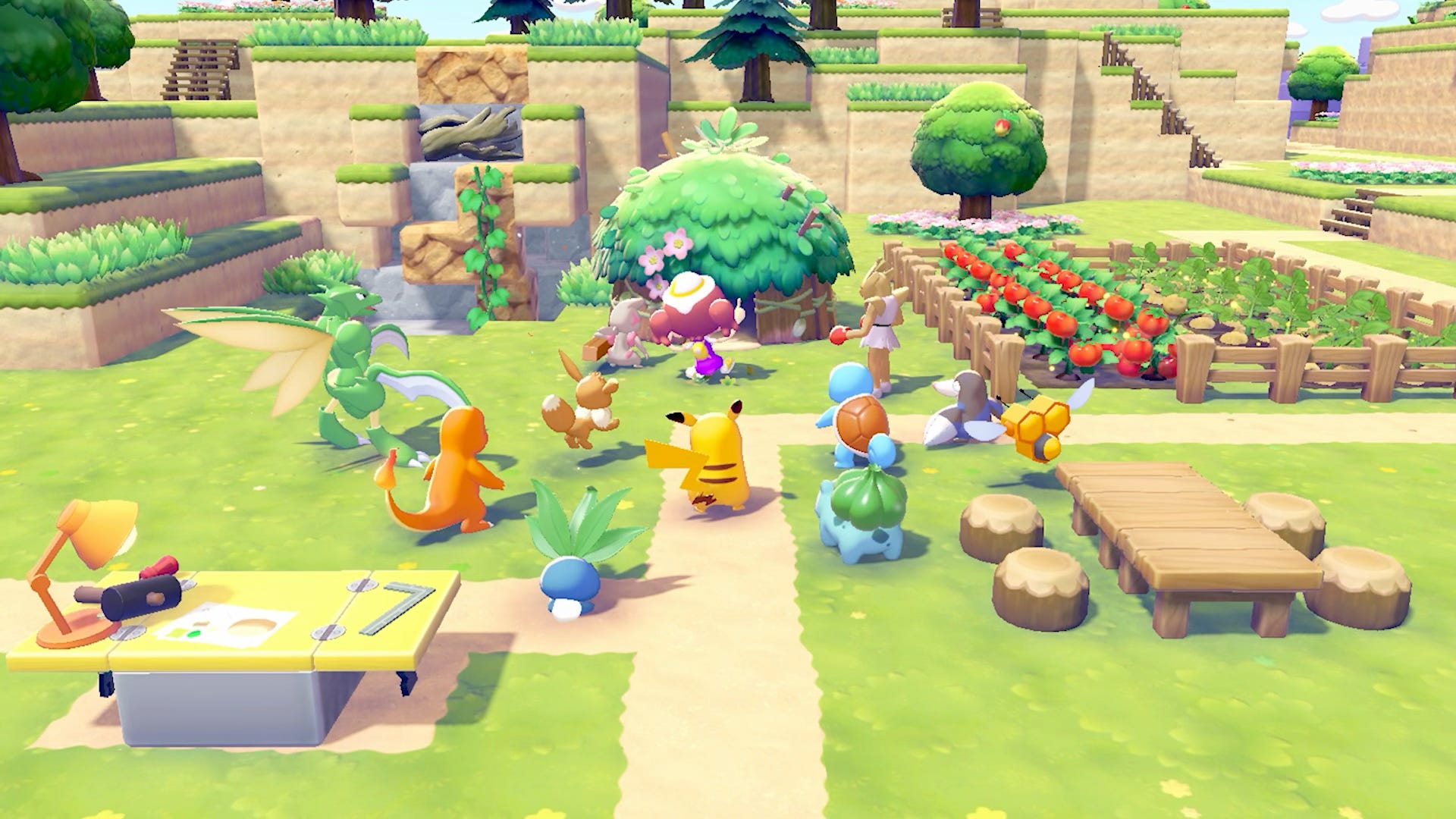
I had a plan for Sunday afternoon: fly back from a weekend-without-kids-in-a-very-sunny-and-warm-place getaway with my wife and write up a a Pokémon Pokopia review on my flight back. Then, my flight was delayed—and delayed. And delayed. And then it was cancelled. And then I had a layover in Dallas, with a 45-minute layover that also required me to jet through customs and take an airport train to another terminal. Deep breaths, Patrick. But I was anxious, annoyed, and really tired.
Normally, having anyone else around—a friend, my wife, the kids—would calm my nerves, or at least force me to put on a brave face in Dad Mode. But alone, I felt a creeping sense of “this is too much.” Typically, I am not a “cozy game” person, but in this moment, dang was I thankful to have Pokémon Pokopia, a new collaboration between Koei Tecmo and Nintendo that’s out this week on Switch 2, in my backpack.
Amidst this stress, there was no greater relief than quietly collecting 20 stones.
Pokémon Pokopia has often been described (including here at Crossplay) as a mashup of Animal Crossing and Minecraft. Having played a number of hours of Pokémon Pokopia on my own and with my nine-year-old daughter, I’m less convinced about the Minecraft part. There’s ample world customization in Pokémon Pokopia, but at its heart, this is a lighthearted game about slowly bringing a world—and a community—to life, one fetch quest at a time. At least in the portion that I played, you cannot make quick and sweeping changes to the world in the way you can when you’ve learned to really wield the tools of Minecraft. It’s charming and calmingly repetitive, but for most people, I don’t think the latter will be a problem. If anything, it’s a part of the pitch!
The basic setup: you’re a Ditto, aka the transforming pokémon, and you’ve taken on the form of a human. You arrive in a place where there are no pokémon or humans. The land is dry, busted up, and in need of a caring hand. Pokémon Pokopia is a task-based game. Collect 20 of these, find 15 of those. It’s slow. The basic loop is building little homes (i.e. a patch of grass) to attract new pokémon, asking those pokémon what they want to feel better (i.e. more food, a cool toy), and gaining new pokémon powers along the way, like the ability to vomit water onto the ground, terraforming the land.
(Watching that animation never, ever gets old.)
In a world of chaos and anxiety, Pokémon Pokopia is a leisurely balm. You aren’t sure what to do, friend? Don’t worry, Pokémon Pokopia has a task for you. It’ll only take a moment, and at the end, you’ll have something cool, hear a neat chime, and someone will thank you for taking time to make them feel a little happier and more comfortable.
When I played an hour of Pokémon Pokopia a while back, I mused on the difference between how I approach video games like this and how my children approach them.
I tend to look at games like this as busywork (derogatory), but my kids look at games like this as busywork (complimentary), because games about organizing and task completions scratch an itch in their brains that doesn’t exist in mine. Our tastes are polar opposites! But I do get real joy out of helping my kids out, and it’s not hard to look at Pokémon Pokopia as a game that might work differently for both my children, and open up forms of overlapping play that gives them (and us) opportunities together.
There is no greater catnip for my two children than a video game where you can organize things. However, they are impatient. They don’t want to grind. Much of this is driven by their ongoing obsession with Minecraft’s creative mode, where they can interface with the world entirely through their own imagination. Whatever object you want, you can have. But that’s not how most games work. Friction—good friction—is core to the experience. At least, that’s the way it’s been so far. In a post-Roblox world, what role is there for “good friction,” and are we headed towards a generational gap?
A question whose answer is too big for this story—and this one game.
But it is a charming game, though describing Pokémon Pokopia as “little” feels like a grand betrayal of a game that very obviously is interested in absorbing gobs and gobs of time. It’s both grand in scope and miniature in the moment-to-moment. It takes time to walk from one section to another, collecting lots of materials s along the way. Time spent waiting for pokémon to finish turning your wood logs into lumber or to build a house. Sometimes, as with the wood logs, you have no idea when the task will be completed. You just come back later. Other times, such as the house construction, the game tells you to come back in 15, 20, 30 minutes, to see what they’ve done.
Go away, suggests Pokémon Pokopia. Find another task. There’s always another.
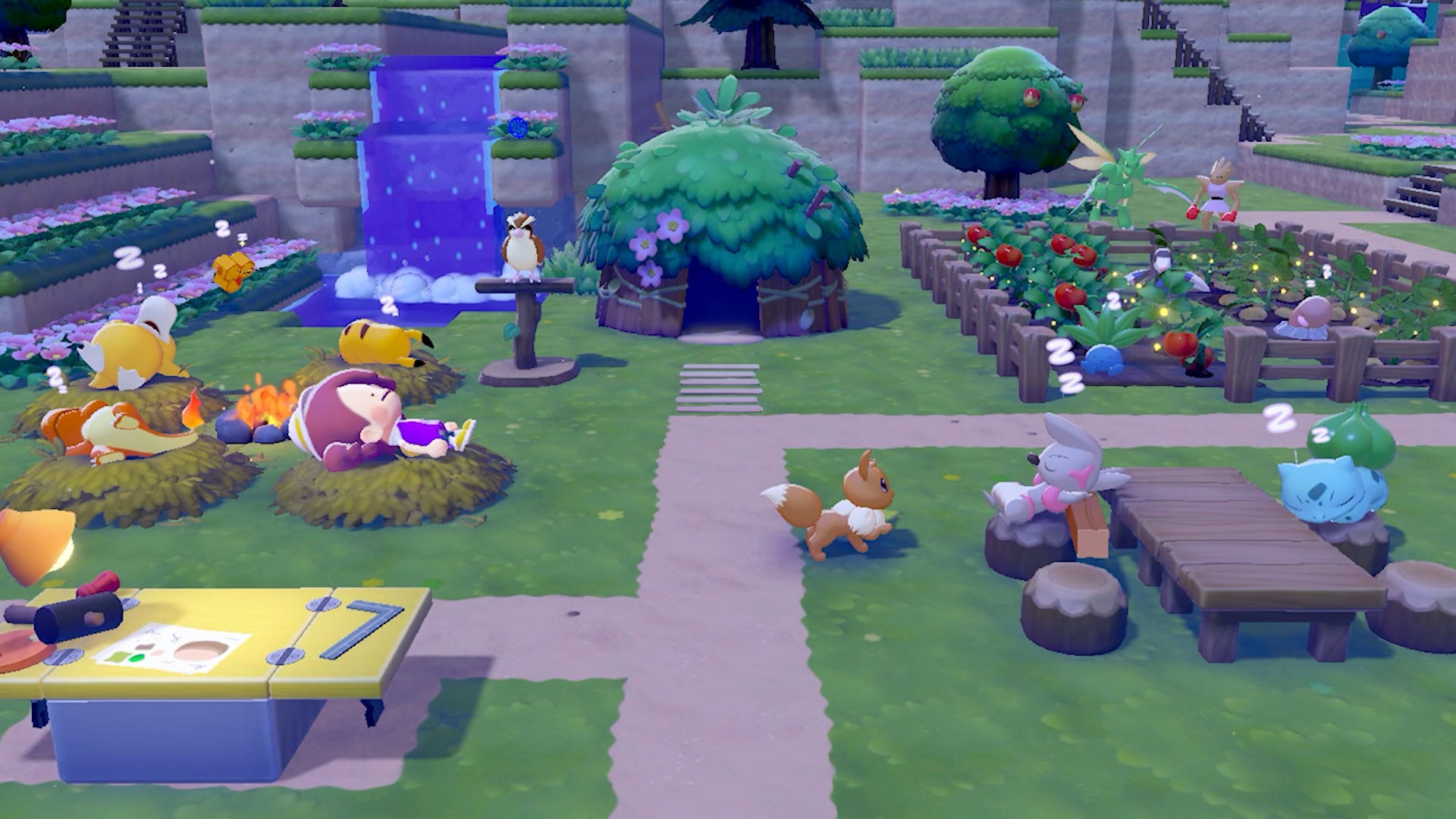
There is no hurrying Pokémon Pokopia. Even while waiting, there’s surely something else to do. A creature that needs your attention. Or a specific amount of items that you need to collect to complete a goal. Accomplishing that nets you coins to buy things in the shop, which is also helping you complete other goal that net you more coins th—are you starting to get it? Have I told you there are “daily” quests, too?
These games are in the eye of the beholder. I can blink at Pokémon Pokopia and go “I bet people are going to really like this,” even when I feel myself chafing at what feels like endless downtime. These are often not my kinds of games, even if I cannot say I had anything resembling a “bad” time in the hours I spent helping my pokémon buddies. But I also felt like there was a better source than myself: my nine-year-old.
Over the past week, she’s dipped in and out. I asked her to play the opening hours, while I sat on the couch, and observed how she responded to it. (Nintendo does not allow me to play games over GameShare ahead of release, so I have not been able to test my ideal setup: my kids playing in “my” world while on their Switches. Stay tuned.) It went a bit like how I expected: many questions about why you could do this and not that. Why do I have to wait to do this when I actually want to do that? I get it.
But she’s also in fourth grade now, which also means she’s doing book reports. So I asked her to write her own review of Pokémon Pokopia, based on a form I whipped up.
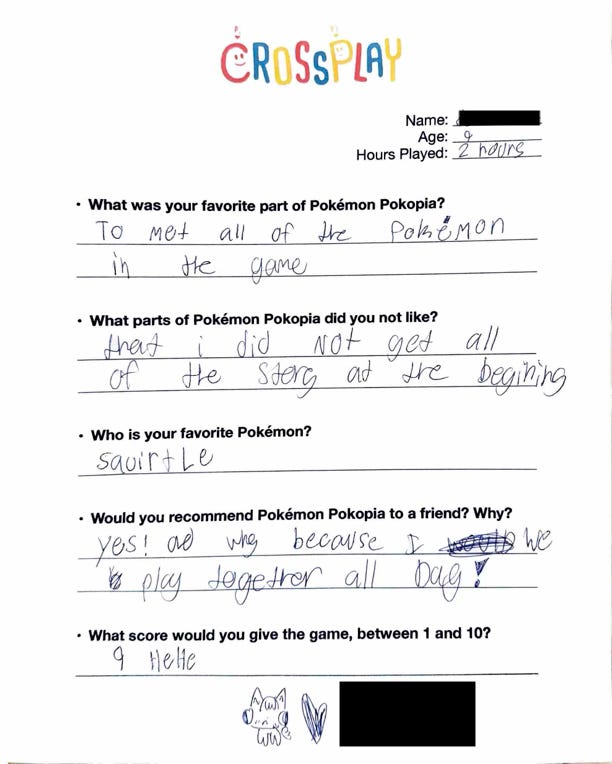
Very good, kiddo. If you’d like to have your child fill out this review, here’s a template.

(Please send me your children’s reviews, for Pokémon Pokopia and otherwise!!!)
Some takeaways from her review:
She loves little creatures, so even though she has not played a Pokémon game before, there was a real pop every time a new Pokémon would grace the screen.
Stranger Things has my nine-year-old on a lore kick, so perhaps I should have had her watch a YouTube video that explains the world of Pokémon before jumping in.
Squirtle is a good choice. I can’t remember what my starter was for the original?
Hopefully, we’ll play together when the GameShare restriction lifts.
The “hehe” really cracked me up.
She told me the drawing at the bottom was “her idea for a new pokémon for Nintendo to use.” I’m expecting a credit when they reveal this in a future game!
Big picture: I liked Pokémon Pokopia. My nine-year-old liked Pokémon Pokopia, too. As for how it goes when all three of us can play the game? I’ll report back soon on that.
Pokémon Pokopia will be available on March 5 for $69.99 on Switch 2. It supports local multiplayer via GameShare for up to four people, which means the other participants can join the host’s world and can also play using an original Switch. Online multiplayer is also available. The game has “cloud islands” that can be shared between a group and accessed without having to have anyone else in the shared group online and playing at the same time.
Have a story idea? Want to share a tip? Got a funny parenting story? Drop Patrick an email.
Also:
The plan was to publish this alongside everyone else’s fancy review when the embargo lifted, and then I fell asleep on my second flight back home. Sorry!
One dynamic I’m expecting is that I might pluck away at the grind-y aspects of the game, while my nine-year-old enjoys all the fruits of the time I spend in it.
Task-oriented cozy games work for me more than “find your own things to do!” games, so I’m going to give this a real go. I want to see if it can fit into my life.
The book report game review format should be mandatory.
That survey covers a surprising amount of ground, huh