

AI Has Come to Roblox
Roblox is promoting its new "4D" AI tools inside an experience called Wish Master—and I've spent time figuring out what it can (and can't) do.


“Wish Failed. Failed to process Wish. Refunded!”
”COOLDOWN: Please wait before sending another Wish.”
These failure states were the vast majority of my experiencing trying to get Roblox’s new AI tool to produce a “Nintendo Switch,” some “Pokemon,” and at one point, a “naked lady,” in a Roblox experience called Wish Master. The experience uses text prompts to search a Roblox model database and, at times, tapping genuine AI to make objects. It did, after a few attempts, try to make a Switch. What I got, though, was this:
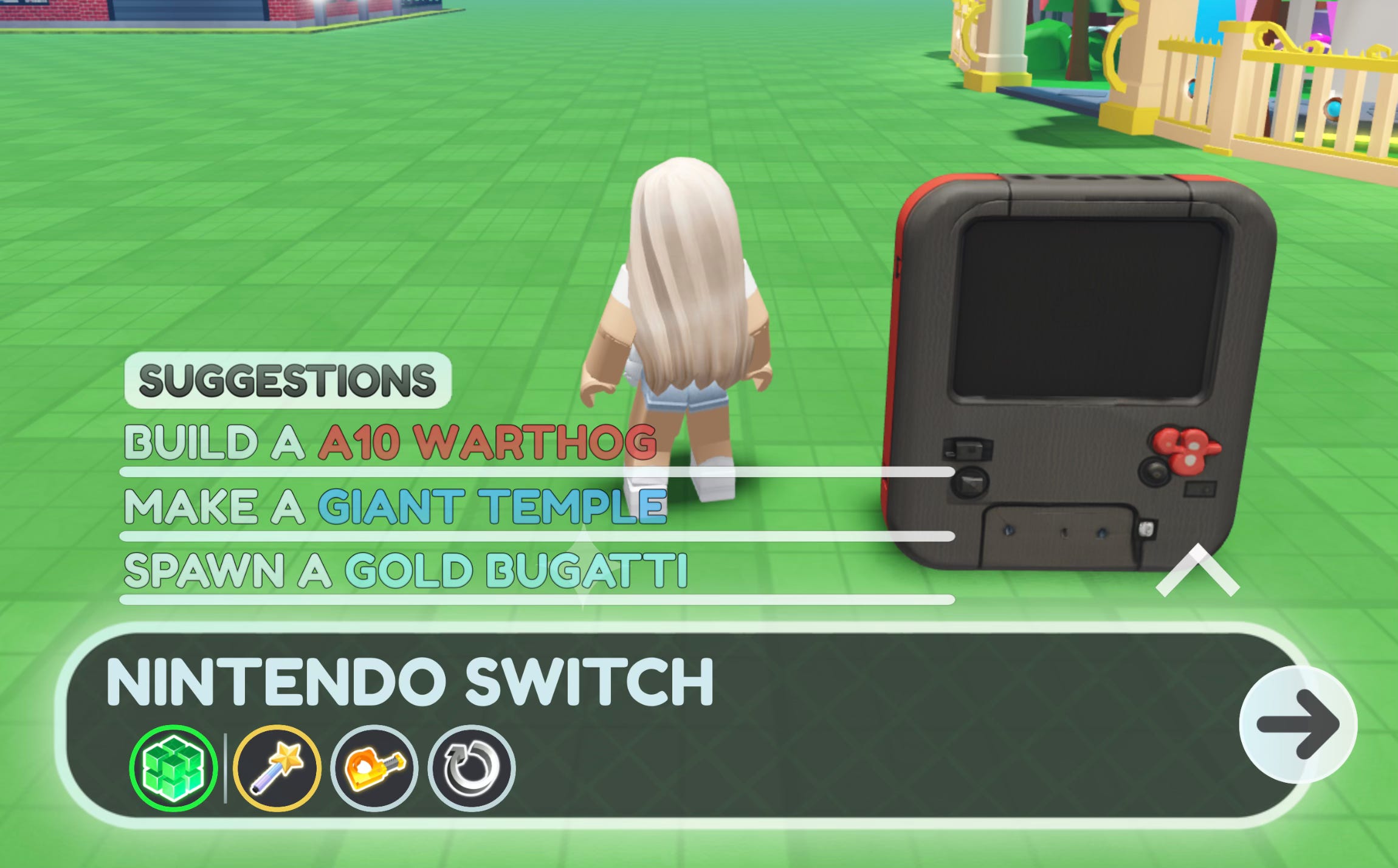
Not sure about that button layout, buddy. And no, it did not produce a “naked lady.”
Wish Master was recently promoted by Roblox as part of pushing its new “4D generation” AI efforts, which bring AI tools beyond developers and into players’ hands. Wish Master, which has been played 3.5 million times, promises “a sandbox game where your wishes shape the world from simple objects to mind bending creations” and a chance to “wish for almost anything and let AI bring it to life!”
“Today, players can use Wish Master’s Basic, Pro, and 4D generation options to create all manner of objects,” reads the announcement from Roblox earlier this month. “Laksh [the game developer] and the team have big plans for Wish Master, including a new AI model for outfit generation, a build mode, and a player-versus-player mode.”
And here’s how Roblox describes “4D generation:”
“While traditional generative AI creates static 3D meshes, Roblox’s 4D technology generates fully functional objects, meaning a player can prompt a pineapple-shaped car, and create an object that already has the wheels, physics, and seat-logic ready to go — all they need to do is hop in and drive.”
What Wish Master actually delivers on is a little more complicated. The experience promise “3 different” AI models called WM Basic, WM Pro, and WM 4D. WM 4D is the only one that actually legitimately taps into AI to produce a creation. The others are only trying to interpret your text prompt and search Roblox’s model store, which is a combination of Roblox-made designs and community creations.
Roblox describes WB Basic as “basic search of a model library; no AI used” and WM Pro as a “text generator, our in-experience LLM API, to understand the prompt and create a smarter search.” You’re basically using a fancy chat bot as a search engine.
It also probably explains why, for example, my copyright-infringing ideas were less successful while trying to tap into 4D, but were way more successful everywhere else.
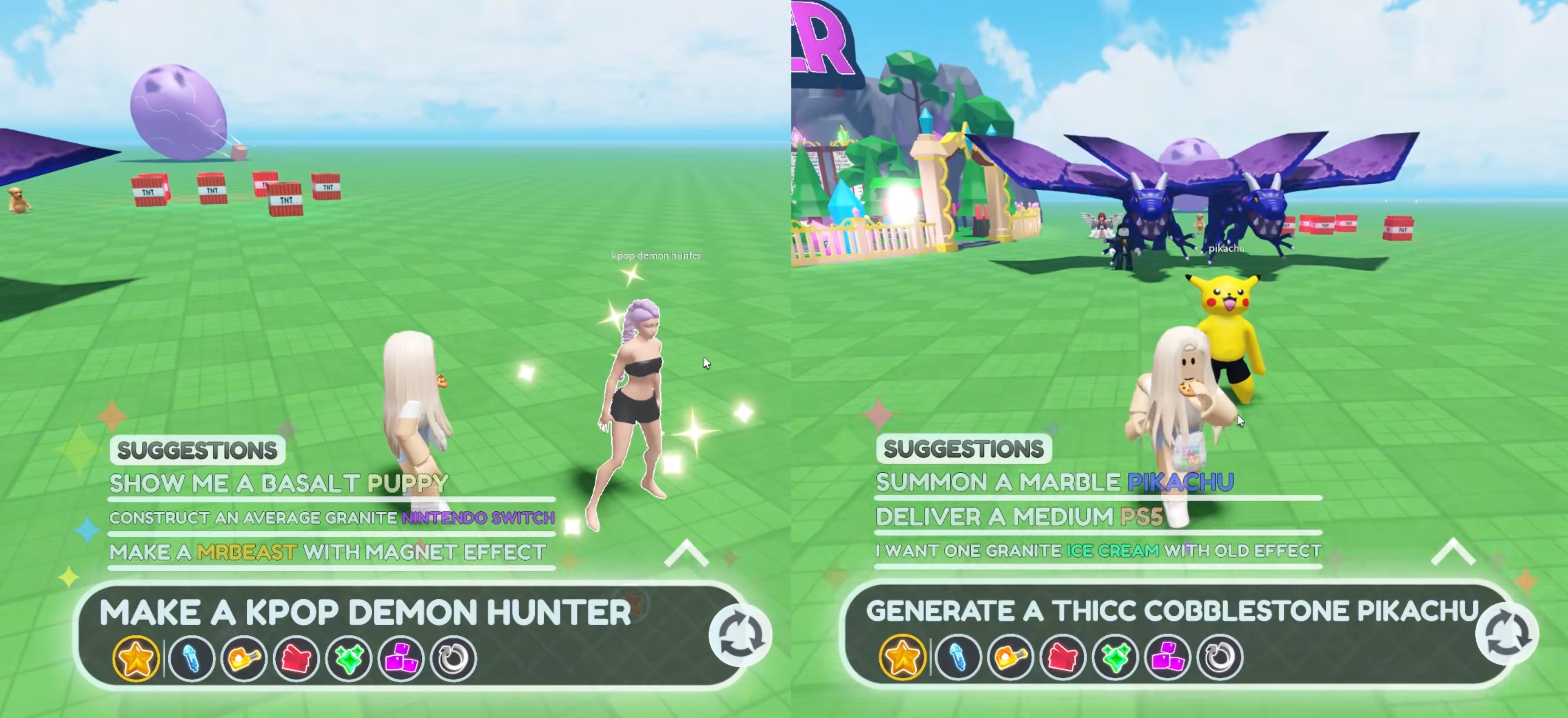
WB Basic and Pro were more than happy to deliver some copyrighted content!
(For the record, the “thicc” idea was recommended to me by Wish Master itself.)
“For our AI models, we have implemented filters to reduce the likelihood that they generate content that is similar to copyrighted works,” said a Roblox spokesperson. “We are continuously refining our approach to IP rights protection in the generative AI space.”
When I asked WB Basic to “make a sexy lady,” the request failed just like WD 4D did, telling me “Wish Failed. Failed to process Wish. Refunded!” That is, I assume, Wish Master’s way of saying “hey, we can’t do that,” but it’s also a problem that you aren’t aware of what the boundaries are. What requests are too far? “Failed to process” is a long ways from saying “what you are asking for is inappropriate, please stop that.”
With WD 4D, my request for it to generate a Nintendo Switch, even if the result was a horrifying nightmare version of it, failed a few times! But if I asked over and over, it tried to produce something. It’s not hard to worry the same logic applies to other topics.
So much of what drives Roblox as a social-first gameplay platform is a mixture of mechanics and role-playing, experiences where players dig through developer-designed pieces of clothing and objects to tailor a story. It’s a natural extension to imagine Roblox using AI to turn a finite number of options into infinity. Do you want a pink dress, but the developer didn’t make a pink dress? All good, 4D will make one!
The difference between then and now is these tools are in the hands of players, bringing Roblox-approved prompts, Roblox’s own take on ChatGPT, into Roblox itself.
And at least right now, there’s no way to ban a child from interacting with Roblox AI.
“While there isn’t a specific control to block all experiences where 4D is leveraged,” said a company spokesperson, “for precise control over their child’s access to specific experiences, parents can block specific experiences to limit their access.”
Which means it is possible to block Wish Master—but you have to do it yourself.
In Roblox, if you click on the “Content Maturity” label, it describes Wish Master as “Al Interaction (Limited)” and “Violence (Occasional/Mild).” It’s not a huge leap to let parents have control over the AI part, unless Roblox’s goal is pushing mass adoption.
Roblox’s own AI tools aren’t the only options. A search for “AI” brings up Roblox experiences that promise you can interact with ChatGPT, a service currently being sued for allegedly encouraging a 23-year-old to kill themselves, or other AI models.
How does Roblox safeguard against a tool that’s being outsourced off the platform?
“We require creators to disclose if they are using AI interactions in their experience, and creators who have extended AI interactions receive a content maturity rating of Restricted (18+),” said a Roblox spokesperson.
The platform’s own guidelines define chatbot use like this:
“Restricted experiences are not accessible in certain regions. Experiences with AI interaction may contain chatbots. Chatbots may not be suitable for some minors, and chatbot experiences with extended AI interaction are only available to age-verified adult (18+) users.”
I’ve asked Roblox for clarity on its definition of an “extended AI interaction.”
All told, Roblox has deserved, and continues to deserve, scrutiny for the influence it has on the lives of young people. But it’s also worth pointing out the times the company has improved, especially when it comes to the parental controls. My argument has always been this: it’s okay if you say no to Roblox in your house, but that does not mean there shouldn’t be pressure on Roblox to keep getting better, because it’s for the benefit of the many millions of young people and families in the ecosystem.
Parental controls promise, in theory, what’s on the tin: control for parents. But increasingly, it feels like one avenue where parents are losing control is AI. Google has started pushing Gemini, its own AI service, on children. YouTube knows its platform is full of “AI slop,” but parents aren’t allowed to turn it off. Now, it’s nearly impossible to scroll through funny animal videos with your kids and know if it’s real.
It’s a simple request: parental controls should extend to AI, too.
Have a story idea? Want to share a tip? Got a funny parenting story? Drop Patrick an email.
Also:
This will likely follow a typical AI playbook, where the tech is quickly pushed ahead of meaningful controls over it. We’ve seen this happen over and over again.
It’s also important to have conversations about AI when age-appropriate, as it’s likely your kids are going to have different feelings towards the tech than you.
Last week, my five-year-old randomly asked if she “could use ChatGPT.” Startled, I asked her what ChatGPT was and she couldn’t give an answer! Okay!
The gap between "Content Maturity: AI Interaction (Limited)" and having zero way to actually block AI tools is wild. You either trust Roblox's filters completely or you block the entire experience manually, one by one. That's a real maintenance job.
The part about "extended AI interaction" being undefined really gets me. If you're building parental controls, that vagueness doesn't help anyone.