

We Wanted to Be Serious About Screen Time. We Changed Our Minds—And Everyone Was Fine
Everyone wants to be the "responsible" parent who follows all the "guidelines." Then, reality sets in. Or, more accurately, a cuddly tanuki by the name of Tom Nook.

When our daughter first arrived, we would turn our phones away from her impressionable eyes. Many will have heard that the WHO recommends no sedentary screen time before age two, then no more than one hour a day until they’re five.
(For the record, upon closer inspection of the WHO guidelines, that’s more about the physical inactivity you also get from leaving them in a high chair or stroller.)
So, how did we end up handing our toddler a Nintendo Switch controller before her second birthday?
Crossplay launched at the perfect time for me: just as I was getting over my morning sickness and able to think more about how we were actually going to parent this child. I’m a journalist whose therapist advises against social media and married to a game developer working on one of those games often blamed for the decline of the industry.
Screen use was a big topic.
To be fair, we always said we’d introduce video games (active) before television (passive); the question was when and how. I remembered a 2014 article in which technologist Andy Baio explained his chronological approach, starting with a plug-and-play device full of 1980s arcade classics on his son’s fourth birthday.
Clearly, we couldn’t even wait that long.
Our initial (admittedly privileged) position was something like: we just don’t want to use screens as a crutch.
We began with baby-friendly movie screenings, special social events. At first, she just enjoyed the vibes, but as she learned to sit and pay attention, my husband worried about the content of these movies—would she be as sensitive as he was? When she cackled at Wicked’s swarm of flying monkeys, we figured she took after me, instead.
Television joined the party when she got sick and we wanted that physical inactivity. After some quick research, I turned to the BBC for a gentle animation called Puffin Rock. She chattered excitedly through the first episode, but then settled into an unsettling silent fixation until we turned it off.
For non-sick days, I found an even less stimulating alternative in a live stream of a real-world puffin colony, though I questioned my choices as a gull chowed down on something bloody. (Something I, perhaps, should have expected from the Puffin Rock narrator telling us these birds “don’t exactly get along,”)
Phones and tablets, as far as our daughter is concerned, are for looking at pictures of herself. I once tried locking down my iPad so that she could draw on it, but Guided Access doesn’t seem to like the Pencil. I also considered looking for a phonics game when we realised she could read the alphabet, but my husband put an uncharacteristic foot down, citing overstimulating graphics.
And in retrospect, I didn’t want her first games to be edutainment—what if that put her off the medium altogether?
Then, we went to Sea Life, a chain of aquariums in the UK, to meet Tom Nook.
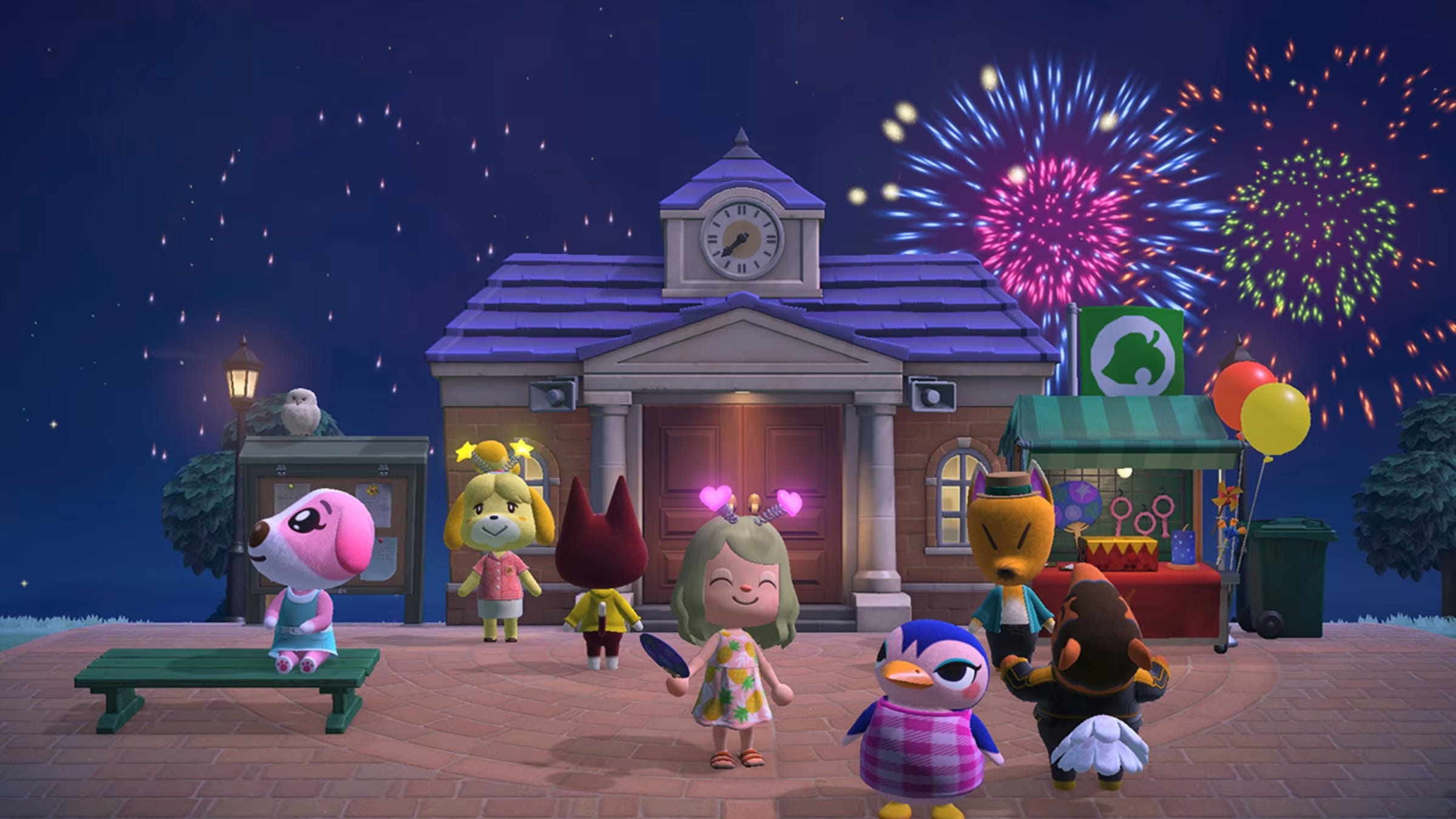
Our daughter fell in love, asking daily to see the picture we took with this giant cuddly tanuki. By this point, we had tentatively played a few chill video games in front of her—ODDADA, Tiny Glade, Dorfromantik—but we decided that Animal Crossing: New Horizons would be the big one. It felt kind of surreal to load up this game from the pre-parent pandemic times, but she was predictably delighted to see Tom, and I was delighted to spend half an hour playing a good video game with my kid before returning to reading her the same book for the hundredth time.
It helps (her and us) that, anthropomorphic animals aside, much of this game is based on the real world. She has picked real fruit and collected real shells, too. She loves to tap through conversations with her favourite neighbours, waggle the analog stick to zigzag around the museum or swim in the sea, and watch me play dress up at the Able Sisters.
When her imaginary play takes on an Animal Crossing theme, it just means things like pretending to fish or put on a wetsuit, or using a “ladder” to climb onto her bed.
“Just as I was getting over my morning sickness and able to think more about how we were actually going to parent this child. I’m a journalist whose therapist advises against social media and married to a game developer working on one of those games often blamed for the decline of the industry. Screen use was a big topic.”
One of the big concerns people have around young kids and games is that they can’t distinguish fiction from reality and might learn the wrong lessons. I had to laugh when our daughter pointed at a picture of cinnamon rolls in a cookbook and proclaimed them to be fossils. And I did find myself telling her that money doesn’t really grow on trees. She also gets very upset if somebody gets stung in the game, but I genuinely think that watching us heal ourselves made her more willing to take medicine the next time she was unwell.
When our toddler throws herself on the floor because we won’t play Animal Crossing before breakfast, I can see why other parents worry that screens have some sinister hold on our children. But then I hear her giggle when we wake a sleeping Blathers, or name the flowers we’ve planted.
On a recent trip, she had a night terror that left us huddled in the bathroom trying to keep her screams from waking the entire floor. I was grateful for the Switch we’d packed and the midnight Animal Crossing session that finally calmed her down enough to settle back down for the night, murmuring “Timmy and Tommy” in her sleep.
 | A guest post by
|
Yeah, I remember my wife and I agreeing that we didn’t want to be one of “those parents” who put a screen in front of their 2 year old at restaurants and such. We quickly found out how much that doesn’t always work.
We also learned that screen time itself isn’t evil. Just need to set boundaries accordingly to the needs of the kiddo. I’m happy to hear your daughter loves Animal Crossing!
Wait, what do you mean the WHO guidelines that every journalist, influencer, and terminally online anti-ipad parent is more about sedentary behaviour in general and not SCREENS BAD???
Also I love that your little girl has taken to Animal Crossing so well. I feel like that's pretty much an ideal game to get kids started with. Low stakes and intensity. Very chill. Really good at discouraging fomo and encouraging pacing (you can NOT just keep playing AC:NH for hours. You will genuinely run out of things to do). I'm going to be borrowing this idea for my own daughter.