

Why Grounded Went All-In on Letting Players Remove Friction From Their Survival Game
Grounded is popular with hardcore gamers and casual gamers, partially because its developers decided to let the audience decide their own path.

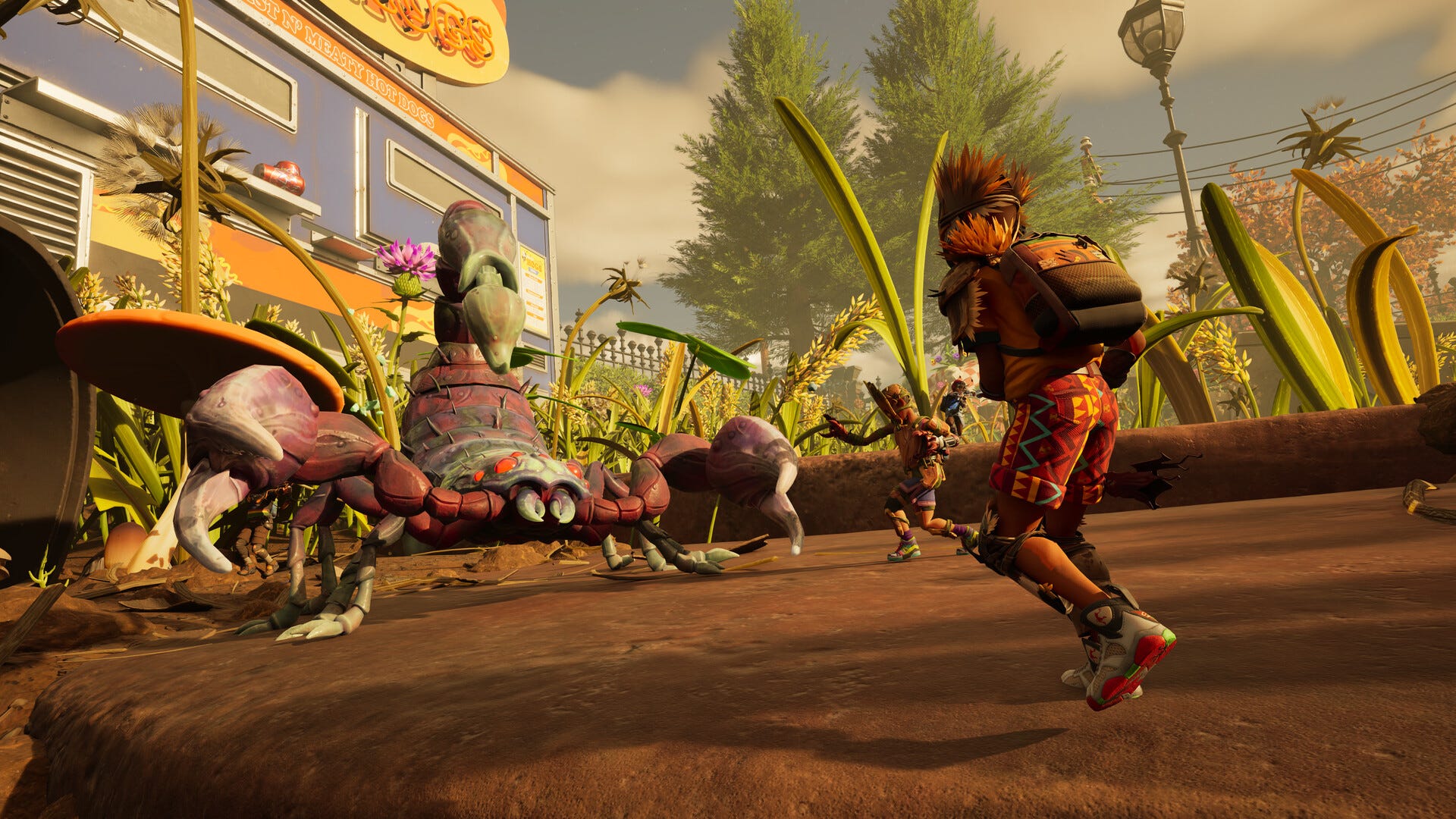
Grounded is the rare feel good story at Microsoft, a company experiencing enormous tumult as it struggles to find a new direction for Xbox, amidst layoffs and price increases. But Grounded, a Honey, I Shrunk the Kids-inspired survival adventure where players work alone (or together) to progress, has been a quiet hit since 2022, in part because it’s a wonderful game for adults, children, and adults playing with children.
“One of the best challenges of working on it [Grounded],” said senior producer Mike Winzeler in a recent interview, “is people that play it and ‘Oh, this is so nostalgic for me because the game is set in 1992. I was in high school back then.’ You have people that are like, ‘I play this with my six-year-old, and we build bases together.’”
I was chatting with Winzeler after spending 10 minutes getting my butt kicked fighting a boss in Grounded 2. We lost, though I’ll blame my mistake of choosing a spider as the creature that came into battle with me. While I am not wholly arachnophobic, I do not mess with tarantulas and the creature I picked was one!
(An early story I wrote about Grounded was about how it carefully handled the inclusion of spiders in its game, even though people might be phobic—or anxious.)
“The focus has always been on making sure you can play the game the way you want to and going beyond just difficulty settings on that,” said Winzeler. “We also have a creative mode. So if you really want to build bases, you can go in and do that.”
My children have spent hundreds of hours in Minecraft—but almost none in the game’s survival mode. It’s entirely “creative,” where they can build to their heart’s content. You cannot die, and Minecraft becomes a virtual form of stacking LEGO bricks. “Enemies” are simply goofy creatures to be part of whatever story they’re telling that day. It’s an extension of the social-first, friction-reduced gameplay dominant on platforms like Roblox and also often seen in modern “friendslop” games.
In Grounded, there’s a “Playgrounds Mode,” where players can assign logic to parts of the game. You could, for example, build a racetrack and have bugs compete. And in August, Grounded’s bringing back custom game settings, which means you can dial in how you want the game to feel. Do you want to make it harder? Turn enemy aggressiveness off, which means you can just wander through the beautiful world?
“You can tailor your experience to what your situation is, whether it’s with your friends or your family, or someone young who’s just getting into games,” said Winzeler. “For us, tonally, we’re always making sure we’re hitting both the nostalgia audience and just letting these characters breathe and be their own pieces of the puzzle. And then on the sort of gameplay mechanical side, just making sure that you can really tweak things and make it work for you.”
Some changes are driven by what the team observes, some comes from the game’s active Discord server. (Winzeler assured me the team is always reading the Discord.)
For some players, games are all about friction. But increasingly, younger players are growing up with expectations of being able to customize experiences, introducing friction where they want it—or removing it entirely. When I was a kid, these were called “cheat codes.” Today, it’s a mixture of “accessibility” and “customization.”
“The focus has always been on making sure you can play the game the way you want to and going beyond just difficulty settings on that.”
“Grounded’s always been about meeting you halfway, “ said Winzeler, “and letting you take it on on your own terms. There are people that don’t want to deal with the fact that when you die, you drop your backpack and all your gear. That’s the deal breaker, so you should be able to turn that off. Anything that’s going to make you go ‘Oh, I felt bad, I feel like you wasted my time,’ or ‘You’re too mean to me,’ it’s just a barrier to entry to any game. If we can find ways to preserve the foundation of what the game is and and let you find a way to love it, we’re all for it.”
It is, by my estimation, one of the great coming changes to design. I expect games to fall into two camps: games with specific, developer-driven experiences where you cannot change anything (i.e. Silksong) or you control every aspect (i.e. Grounded).
I also expect this to be wildly divisive among the players who enjoy the former, which is why you saw handwringing over Mina the Hollower, a great and traditionally challenging game that lets players granularly modify how much of the game works.
Whatever you make of that shift, Grounded has proven very popular with families.
I asked some parents to explain why this survival game has become the game to play with their kids. To kick things off, here’s John, who plays with his nine-year-old son:
“I think what worked best for us was the exploration, progression cycle, and base building. My son loves being able to explore in games, and each new area brought some new kind of challenge for us to uncover and figure out. We also got to customize our base and re-design it easily as we needed more room or gathered more resources. Sometimes we’d surprise one another by making base upgrades in-between the times we could play together.
One real-life takeaway from these games is that they’ve helped him become more curious about bugs, and gotten him over the fear and disgust of seeing bugs outside of the house. We can now recognize & name a good variety of bugs, and it has led him to be much more curious to learn about that ecosystem instead of stomping it away any time they’re encountered.”
And Brandon, who’s played on and off with his two sons, ages 12 and 19:
“The three of us played Grounded every day in the summer of 2024. They’d play together during the day while I was at work, then I’d come home and they’d tell me over dinner all the things they had collected/built/discovered during the day. After dinner, all three of us would play together for hours... that’s when we’d do all the story missions/quests and venture into the labs so we could see the cutscenes together. After they went to bed, I’d often play solo, just restocking our resources or figuring out what we’d do the next day. We built a huge base right in between the tree and the pond, we each had our own pet bugs that we’d have following us around, and we wound up coming up with an elaborate zipline system all over the yard.”
There’s also Nick, who’s played with this 15-year-old son since since he was around 11:
“After playing through the initial missions that were pretty much designed to teach you the systems I turned everything to what is basically creative mode and those settings were pretty granular. So we kept things like enemy bug behavior, but turned off hunger and thirst because my son was like, “Starving is not a game”.
What we really enjoyed about Grounded was the ability to collaborate on a single game instance together or separately. My son has his own Xbox login and could launch Grounded under his profile, build, farm and gather materials in our shared world even when I wasn’t around. Minecraft makes you pay for that type of shared persistent world, but not Grounded. I made a meta game using that feature where I would build secret caches of supplies and little outposts full of armor and he would explore the world on his on time to find the things I had hidden.”
Maybe it’s finally time to give Grounded a try with my nine-year-old.
Have a story idea? Want to share a tip? Got a funny parenting story? Drop Patrick an email.
Also:
Making games customizable doesn’t ensure success. Elden Ring was a massive hit a few years back, and it’s one of the hardest games around. There’s no easy mode.
But even when developers like FromSoftware don’t include options, players will modify the game to make it easier. This mod’s been downloaded 500,000 times.
If players are going to do it anyway, why not include options from the developers, as with Mina the Hollower, where they have fun with it? More, please.