

Why Do So Many Children Love the Delightful Horror of Poppy's Playtime?
A big question with, perhaps, some simple answers: kids like to be scared. But, of course, there's a lot more going on.

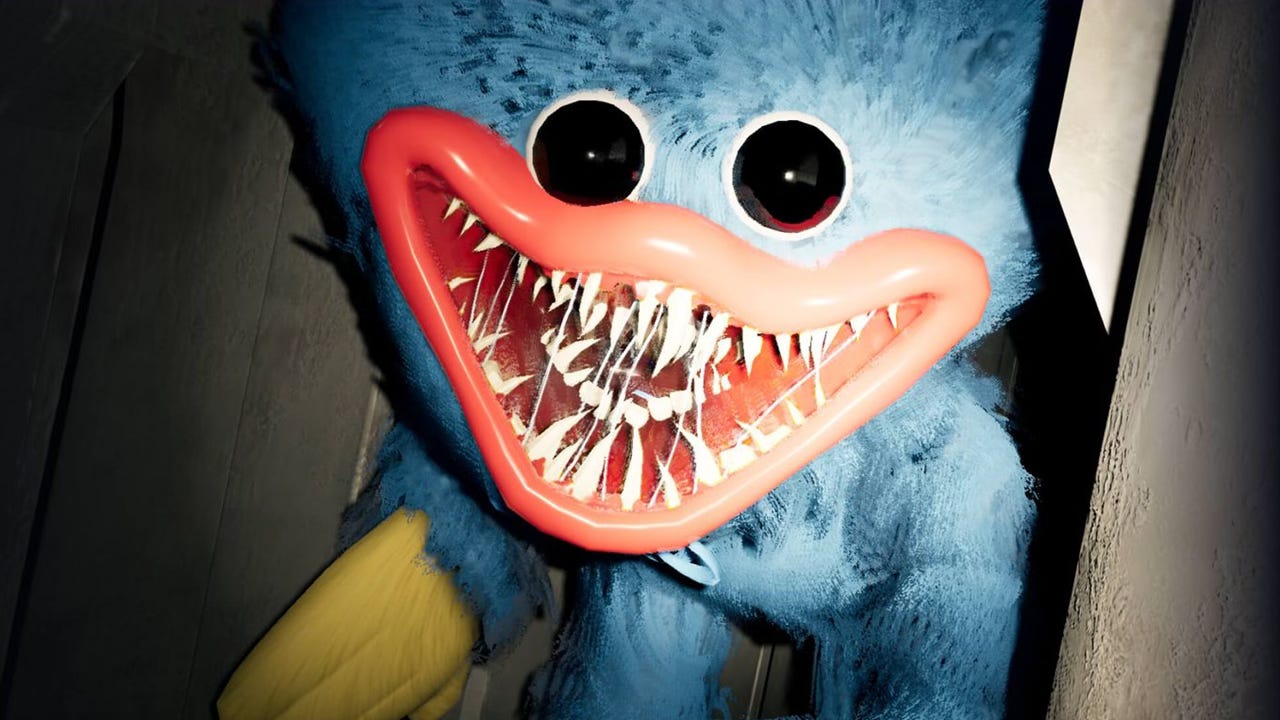
During last year’s Halloween parade at my children’s school, there were two constants among the kids: KPop Demon Hunters and young adult horror you’ve probably heard of, like Five Nights at Freddy’s, and young adult horror you might not have heard of, like Poppy’s Playtime. The face of Poppy’s Playtime is a blue monster named Huggy Wuggy.
There is a good chance, at least, that you’re familiar with that ugly mug above.
Poppy’s Playtime, a survival horror series kicked off by a retired toy employee who returns to an abandoned factory to only stumble into the former toys having become monsters, is one of many horror worlds conceived in the wake of Five Nights at Freddy’s. Huggy Wuggy wouldn’t appear until 2021. Freddy Fazbear started in 2014.
But they both are enormously popular with younger audiences, even if those audiences often do not play the games and may not even like being scared that much.
So popular, in fact, that eight-year-old children wear Huggy Wuggy costumes. (It’s a cool design!) There are toys at Target. And, of course, there are plans to turn Huggy Wuggy into a movie. It’s a world that’s expanding beyond games, even if games remain a big part of Poppy’s Playtime. A new chapter—the fifth—came out last month.
George Krstic was hired last year to become “senior director of creative development for film and games” at Mob Entertainment, the company behind Poppy’s Playtime. The press release announcing Krstic’s hire used flashy (and often ominous) buzzwords like “transmedia,” aka we want to be more than just a game. Krstic has spent decades writing for games (League of Legends) and TV (Star Wars: The Clone Wars, Transformers: War for Cybertron), which makes him a decent and interesting match for Huggy Wuggy.
“We make a game for many types of people, many types of players, and some of those are children,” said Krstic. “We want to have stories that they can relate to. Some of our main characters are children. We want to keep that in the frame of mind as we’re telling these stories.”
Like Five Nights at Freddy’s, the Poppy’s Playtime games are rated “T” by the ESRB:
“As players use robotic arms to interact with the environment, they can be surprised by dramatic jump scares. Monsters/toys are killed by various means: a monster crushed under a falling gate; a toy caught in a grinding machine, screaming while slowly crushed; a toy electrocuted, resulting in toxic gas and burning. Blood-splatter effects accompany monster/toy deaths, and several environments are stained/splattered with blood. Some black-and-white surveillance footage depicts human characters killed by toys, with corpses strewn on the ground. The words “p*ssed off” appear in the game.”
Children being attracted to scary stories is not new. It’s also not new for companies to be actively pushing it on children. I mean, they made goddamn Robocop toys, and the gap between the violence in Robocop and Poppy’s Playtime is several oceans wide.
“Children are drawn to danger and darkness and boundaries, right?” said Krstic. “They just naturally do that. Why are you walking into traffic? Why are you going into the closet? Why are you picking up that knife? It’s like they’re drawn to it. I think that’s how they find themselves.”
Our family is in the midst of watching Stranger Things together. My wife and I have seen the whole series, but all the marketing around the final season nabbed the attention of my children and we’ve been working our way through Hawkins, usually one episode at a time. (This week, we wrapped up season three and everyone, including me, was a mess at the end.) It’s a scary show, one that explicitly pulls on all sorts of 80s horror tropes that defined my own first encounters with being scared by a piece of media, and it’s clear my kids are using it to push their own boundaries, too.
“Children are drawn to danger and darkness and boundaries, right?” They just naturally do that. Why are you walking into traffic? Why are you going into the closet? Why are you picking up that knife? It’s like they’re drawn to it. I think that’s how they find themselves.”
My nine-year-old, for example, has spoiled the series by watching endless videos. But it’s been useful, because my five-year-old (almost six!) will get upset and scared when someone is in danger and ask her sister to spoil the show to make her feel better.
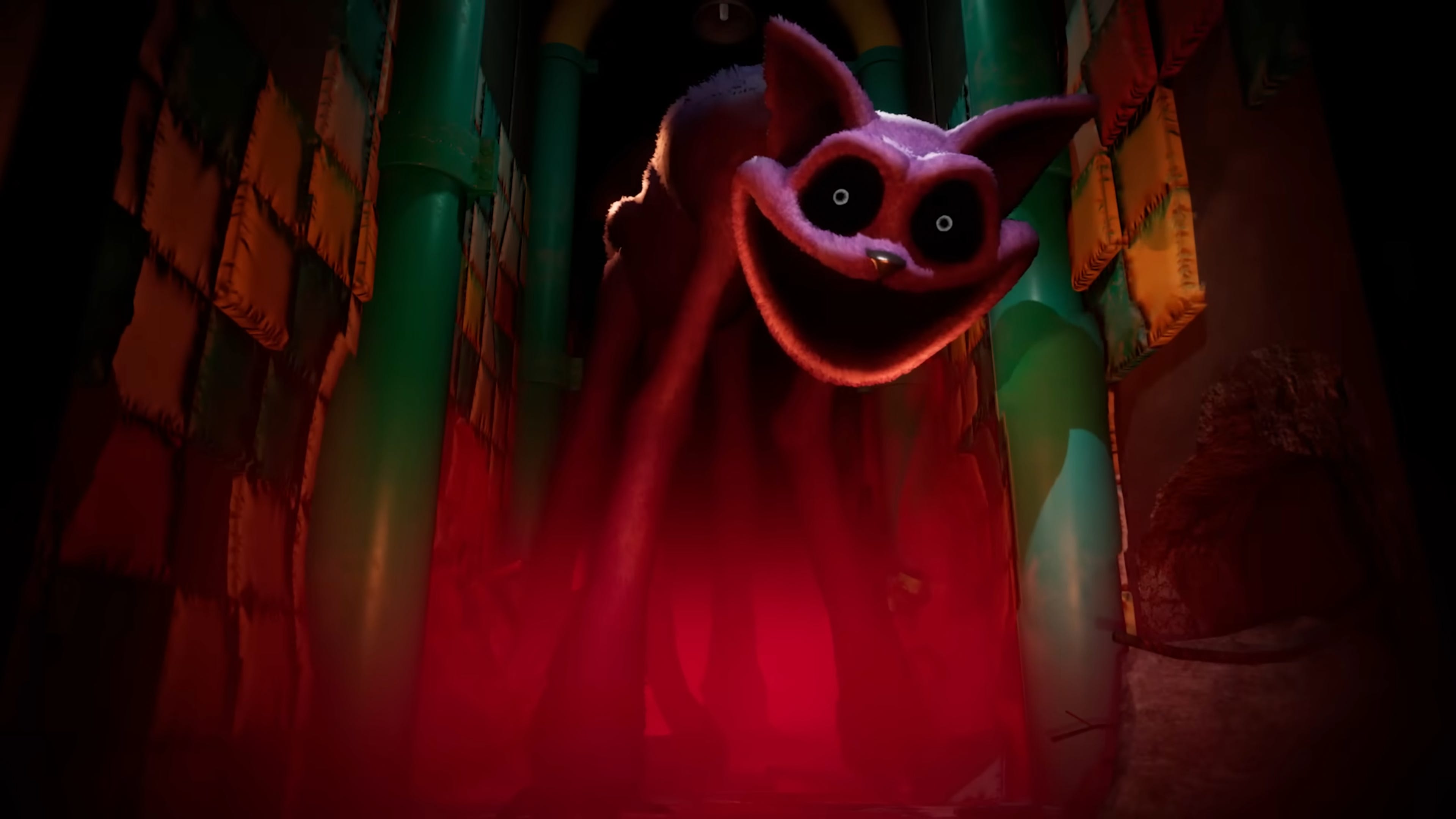
“I think that there’s a flavor of that to [Poppy],” said Krstic. “Our character design team, they’re just brilliant in that they match creepy with cute. They give you the right balance, where it doesn’t edge too far into body horror or threatening horror. And then also it’s very appealing and approachable and cute.”
Gremlins were cute. Pennywise is less cute, but you still see kids imitating him. You can see why kids might think characters from Poppy’s Playtime, like CatNap, are cute:
“We worked with George Lucas closely to create the Clone Wars,” said Krstic. “There was a moment where we realized we needed to speak to a younger audience, because the initial path forward was was pretty adult. Then, we created Ahsoka. She was our eyes in to the story. Someone younger, someone that people can relate to that maybe don’t know [Star Wars] and are a different generation. That was a big learning [moment] that I’m constantly taking forward— know your audience, know their POVs, and always build on ramps and not broken ladders.”
“On ramps and not broken ladders” is a great way to put it. Part of Stranger Things’ magic is how the characters function as a nostalgic hook for adults and point-of-view for a younger audience. “Young” is relative. A teenager can look at Nancy. A grade school kid can look at Dustin or Eleven. My five-year-old even has someone like Holly.
It makes perfect sense, then, for worlds like Poppy’s Playtime to take similar lessons. It’s part of an ongoing cycle of kids seeking out ways to feel afraid (and safe) at the same time. The difference these days is we’re using “transmedia” to describe it, when it’s really not much different than what was happening for me as a child of the 90s.
“It’s like it’s that dark ride at Disneyland. when your child is holding your hand but still enjoying themselves,” said Krstic. “I think that’s where we are. That emotion that we’re trying to capture where it’s like, ‘Are we going to be okay?’ But deep inside, you know are going to be okay.”
Also, let’s just be clear: jump scares are fun.
Have a story idea? Want to share a tip? Got a funny parenting story? Drop Patrick an email.
Also:
The Poppy’s Playtime games seem like better “games” than Five Nights at Freddy’s, though I have to admit I’ve only played the security camera ones.
We are considering buying tickest to see the Stranger Things animated premiere in movie theaters, though regrettably the nearest theater is nearly an hour away.
Okay, by “considering” I mean that I just purchased tickets, because if my kids found out we could watch it in a movie theater and didn’t, they would kill me.
Transmedia? Is woke back???