

Video Game Ratings Icons Aren't Enough Anymore
In an era of Roblox, the little "E" or "T" simply doesn't cut it.

My daughter has just turned two, so she’s not playing video games just yet. She’s curious and really likes poking the controller buttons. She can even tolerate sitting on my lap until I find a checkpoint to quit whatever game I was frantically playing while she napped.
Still, a part of me is already anticipating her forays into gaming. Another part of me expects her contrarian toddler mindset to extend to games. Maybe she won’t be into them at all. But if she is, she will need my help—to play and understand, but also to choose. I’m not naive in thinking I’ll have full control over what she ends up playing as she gets older. (Cue memories of wildly inappropriate games I played at a wildly inappropriate age myself.)
A very unscientific self-selection survey that I ran on Bluesky revealed that parents with gamer kids, when in doubt, do their own research on specific games. Looking at reviews on Google, watching playthroughs on YouTube or Twitch, and sometimes researching the studio or developer behind it.
Not a single reply mentioned game ratings, except for this delightful person who recalled their own childhood experience:
“My parents never played video games but let my younger brother and I pick out games based on their ratings.”
My mind rebels at the idea of looking at ratings to determine if a given game is kid-suitable. What am I, my parents? Still, that’s the first thing I think about when imagining making a game purchasing decision. Someone has done the work to review the game, to make my job as a parent easier, so why not use it?
Ostensibly, this is the reason the Entertainment Software Ratings Board (ESRB), responsible for rating interactive entertainment in the US and Canada, exists. I’m used to seeing the black and white rectangle on game jackets at Gamestop and EB Games, as well as in game trailers on Steam and the like.
The ESRB’s rating classification and similar systems in place in other countries, like the Pan European Game Information (PEGI), struck me as reductive and overly broad.
The criteria by which rating authorities determine their ratings include the usual suspects of violence, sexual content, nudity, gambling, and substance use, including tobacco, alcohol, and drugs. There are subtle differences in how the ESRB and PEGI approach different content warnings, but their idea is similar: broadly, the less explicit or realistic these content themes are, if present, the lower the rating.
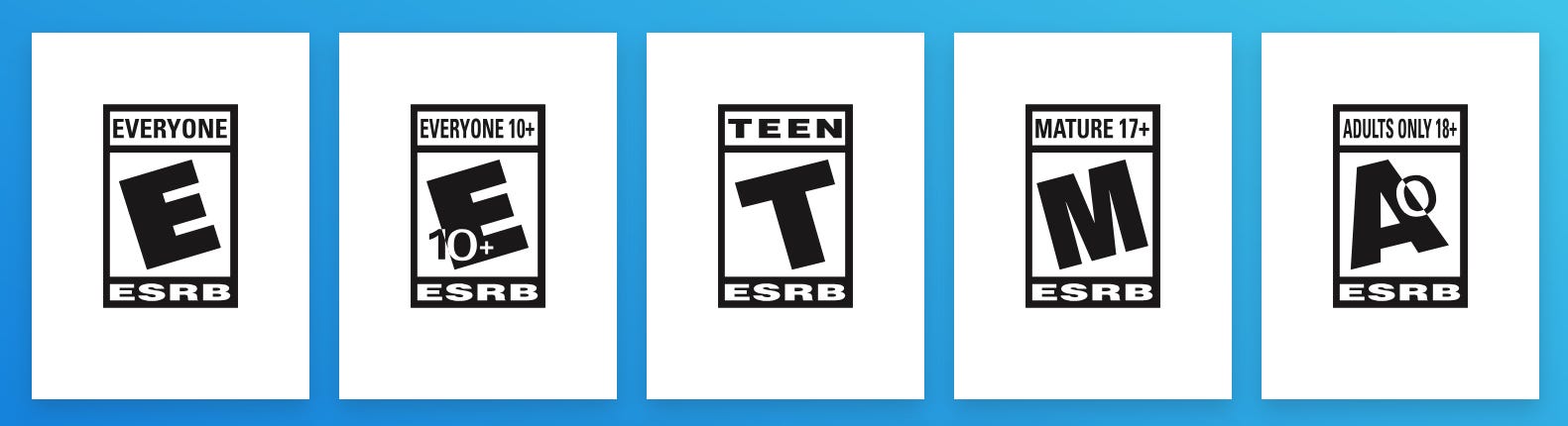
Within ESRB, there are five ratings possible for a video game: “E” rated for everyone, “E10+” rated for everyone 10 years and older, “Teen” rated for, I suppose, kids 13 years old and older, “Mature” rated for 17+, and “Adults only” rated to folks over 18.
PEGI uses numbers and colours for achieving essentially the same thing: 3 rated for kids over 3 years old (green), 7 rated for kids over 7 years old (green), 12 rated for teens over 12 (orange), 16 rated for teens over 16 (orange), and 18 rated for folks over 18 (red).

Mild cartoonish violence and some mild language are allowed in games rated E for everyone. Blood is rated T for Teen, as are “suggestive themes.” Intense violence and sexual content are 17+. Simulated gambling is A-OK for teens, but gambling with real currency is 18+ only, as is graphic sexual content and prolonged scenes of violence.
Age, as the crux on which the whole system rests, is the ratings’ biggest weakness.
Everyone’s idea of “age-appropriate,” let alone what constitutes a “mature” theme, is wildly, wildly different. Violent content generally falls lower on the rating spectrum than sexual content or gambling, but some parents may feel differently about this hierarchy. It sticks to sweeping generalizations by design—it has to. '
A convenient, clean, and tidy system of five ratings would be impossible otherwise.
Its lack of specificity is even more evident with Roblox, a platform with a mind-boggling user count of upwards of 150 million and millions of user-generated games. Moderating them alone is a gargantuan task. Giving these games an official, board-approved rating? So far, nothing.
Since ESRB et al cannot ignore Roblox, their solution is to slap it and other platforms like it with a “Diverse Content: Discretion Advised” content warning and move on. PEGI does the same with an exclamation mark “!” rating that reads like so: “PEGI!”
Go on, parents, figure it out yourselves.
(At least, PEGI has been rethinking its approach to rating games with in-game purchases. As of June 2026, games with loot boxes and battle passes will be rated at least PEGI 16, signaling a turn towards more control when it comes to spending real currency.)
My daughter will certainly start with games that my husband and I pick for her, games that we have played ourselves or know well. But there will come a point to consider games for her that I have no first-hand knowledge of. There, I’ll need help figuring out if they could scare, confuse, or upset her. If they are, gasp, age-appropriate—the very thing interactive software ratings boards set out to accomplish with their video game rating classifications.
Is it nearly time to call ratings boards obsolete?
They certainly still matter to game publishers, whose reach can be altered by a restrictive rating, but they’re less relevant to consumers than before. Even sites like Common Sense Media are more top-of-mind for parents than ESRB/PEGI. Readily available resources, more tailored to parents’ needs, make direct research of games possible, bypassing some ratings board that cannot account for each child’s specific interests and sensitivities. The ratings boards fail because they’re an attempt at a one-size-fits-all, where one size just isn’t possible.
Game ratings won’t be a surefire way for me to choose games for my daughter. I won’t rely on them to decide what my child does and doesn’t get to play. I’ll look, sure, if they still exist by then, but I’m already resigning myself to researching each specific game, playing it, or at least looking over my kid’s shoulder sometimes when she plays. I don’t know if she’ll take to Roblox or another big gaming platform that comes after.
All I know is that I will have work to do if I want her gaming experience to be safe and entertaining while she’s little.
So, more homework for us parents. As usual!
 | A guest post by
|
A good summary of the state of game reviews.
Have you seen the family gaming database? https://www.familygamingdatabase.com/en-us/home
As someone who works in the trust and safety side of a video game company, Nex Playground, what could we implement to make it more worthwhile for you? FWIW - we are committed to a PEGI 3 & 7 catalog as a family-first console.
One role the ratings can still play is to provide a default gate when you enable parental controls on the consoles. However, you might still disagree with them; I approved my 9 year old to play Stardew Valley on her Switch as the PEGI 12 rating seemed overly cautious about some content.
Away from the official bodies I recommend the Family Gaming Database which also covers things like skill level for going beyond just content warning to actual recommendations.