

What It's Like to Make a Bluey Video Game
Bluey is the biggest thing in the world for most children. Halfbrick was tasked with turning the beloved television show into a video game. No pressure, right?


Part of what makes Bluey work, part of what makes the Heeler family feel magical, is that it taps into something that, once upon a time, Pixar did with regularity. It was entertainment for the whole family. You had a great time as an adult and as a kid.
The first Bluey video game, simply titled Bluey: The Videogame, was not able to accomplish the same task. My children had a great time running through the Heeler house and playing “Keepy Uppy,” but I was bored out of my mind. It was empty calories, the opposite of Bluey at its best. I found the game profoundly disappointing.
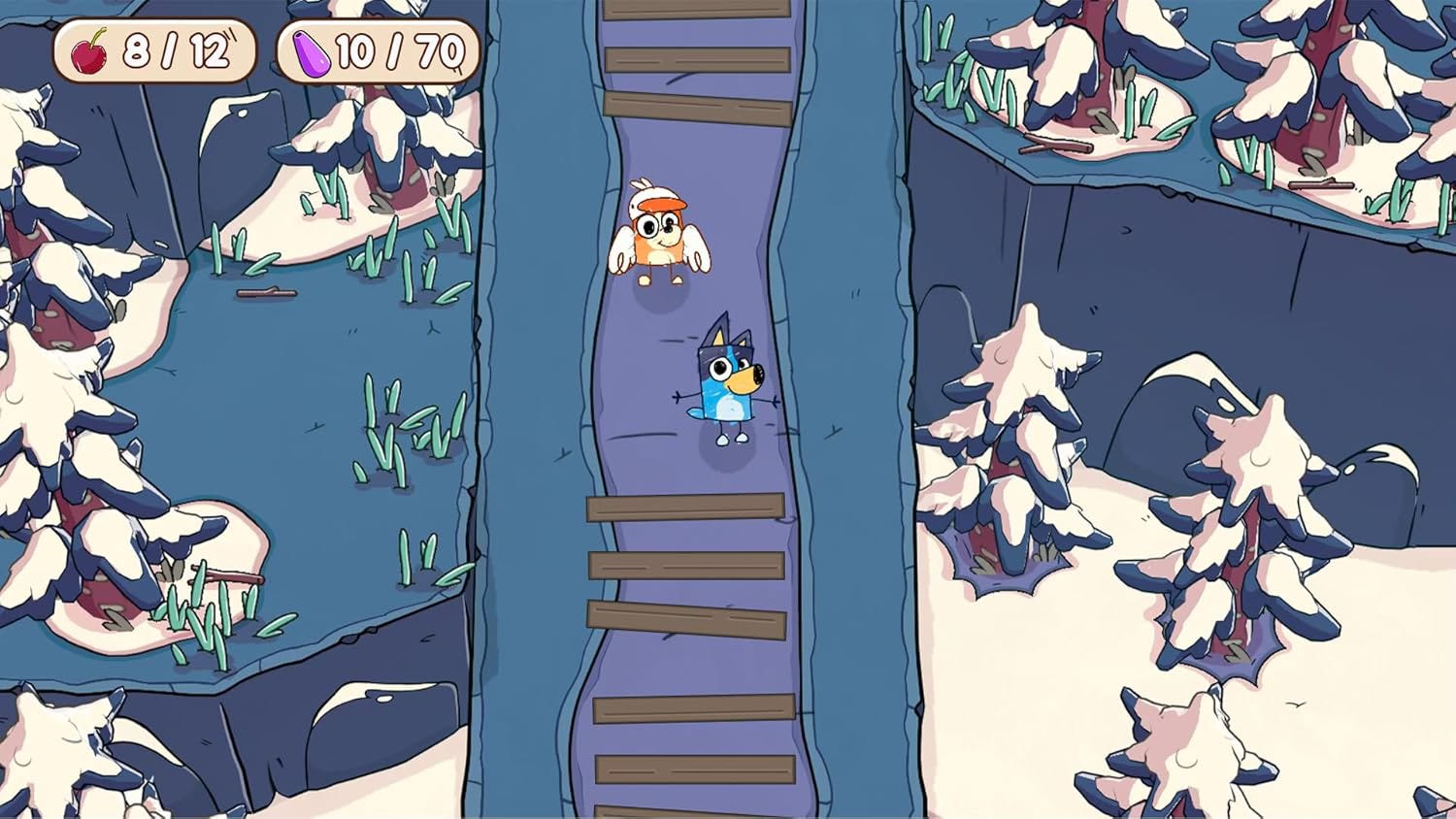
While a full review is coming this week, I’m happy to report that Bluey: The Quest for the Gold Pen, a cute adventure game with light puzzle elements that’s first launching on Apple devices, holds itself to a higher standard. It’s aiming to be a peer to the TV show, and is something both my nine-year-old and five-year-old have enjoyed playing.
“Everything that Joe Brumm writes works on many different levels,” said Shainiel Deo, CEO of Quest for the Gold Pen developer Halfbrick, in an interview with Crossplay. “We set out to create a game that younger players can play, but the parents could join in on the fun and have a great experience, as well, whether they played it themselves or the ideal case, where kids and parents are sort of playing together and looking over each other’s shoulder.”
(Joe Brumm is the creator of Bluey. One day I’ll find a way to chat with him, too!)
The Quest for the Gold Pen pulls on several episodes in the show where the family enters a world of imagination based on their drawings. Halfbrick had pitched a number of different ideas for where the game could be set that Brumm rejected. Dropping The Quest for the Gold Pen in a more fantastic locale was an idea pitched by Brumm, who loves games, himself. In the game, you seek out gnomes, gather candy, use a magic wand to push objects, and more. It’s not deep, but it’s not shallow, either.
Figuring out what the player and Heeler family could do was a big part of the process.
“We did all of the usual things you do,” said Deo. “What enemies do we need to have, in terms of obstacles? What actions can we have? But you don’t want Bluey going around harming other entities in the game and you don’t want them displaying risky behaviors. When we shifted it to imagination, we also thought about, ‘Okay, are we really going to have enemies in this, or can we do it in a way where it’s not so much about combat, but it’s about traversing a world and chasing after the villain?”
The villain, in this case, is Dad, aka Bandit. Nobody wants to hurt Bandit!
I cannot say that my children apply the same philosophy to their own father.
Deo and Brumm are similar ages and with similar nostalgia timelines, which is why you might play The Quest for the Gold Pen and realize “oh, right, they love Zelda.”
Making The Quest for the Gold Ben was, as Deo puts it, a “genuine collaboration.” This was not a game outsourced to Halfbrick; Brumm was throwing ideas back and forth with the team. Sometimes Brumm had an idea and sometimes Halfbrick had one.
While Bluey pulls from Brumm’s life experiences and creative ideas, he works with a team. It meant Halfbrick had a rare opportunity: writing lines for the Heeler family.
“He [Brumm] wrote a fair chunk of the main script for the game,” said Deo. “We have an amazing in-house writer, as well, who has done a lot of things. He came from an animation background, and he’s been at Halfbrick, in one form or another, for many, many years. I always rate him up there with Joe. […] Most people would not realize that a chunk of that in-game dialogue is written by someone other than Joe.”
If “Halfbrick” rings a bell, that’s because it’s the same developer behind Fruit Ninja and Jetpack Joyride, two early breakout mobile game success stories. Both are still kicking around, too. (You likely saw Fruit Ninja at the nearest Dave and Busters?)
“My philosophy was always, ‘We’re going to make the best game we can with the time and resources that we have available.’ Back then, the timeframes [were] quite tight. The budgets [weren’t] usually the best. But we always gave it our best. Our games would review eight out of 10 or something like that, which is good for kids.”
The reason Halfbrick is behind Quest for the Gold Pen is a quirky turn of fate; both Halfbrick and Brumm are in Brisbane, Australia. In fact, Deo and Brumm are only minutes from one another, a discovery only made when pre-Bluey Brumm was looking for a partner to help him make a video game based on his web series, Dan the Man.
“I was thinking, ‘Wow, whoever made this Fruit Ninja game obviously knows what they’re doing. I might get in touch with them and see if they want to make this game,’” said Brumm in an interview published by Halfbrick in 2024. “I got online and I was thinking that the studio is probably based in San Francisco or LA or something, but Halfbrick was in Brisbane, same as me.”
The collaboration between Brumm and Halfbrick became a side-scrolling action game called Dan the Man that’s still successful. It helped popularize the Dan the Man ecosystem, and Brumm has credited that success with giving him time to develop what would become Bluey, Brumm’s attempt to give Australia its own Peppa the Pig.
It also meant that Deo saw Bluey before the rest of the world.
“I saw that first [Bluey] pilot ages ago and I showed my kids,” he said.
These days, Bluey is one of the biggest things in the world. That Disney has not outright purchased the rights to exploit Bluey every which way remains a tiny miracle.
Bluey: The Videogame made sense. Though licensed games have come a long way from the trash of the 80s and 90s, resulting in fantastic experiences like Batman: Arkham Asylum or Insomniac’s Spider-Man games, it’s not the same for licensed games explicitly aimed at children. There, in the muck, are still games that exploit naivety.
“Halfbrick has worked on a lot of games based on kids license properties in in the past,” said Deo. “That’s how we got our start.”
The studio’s early history is ports of existing licensed games (Rocket Power: Beach Bandits) or their own takes on properties like Avatar: The Last Airbender and Hellboy.
“My philosophy was always, ‘We’re going to make the best game we can with the time and resources that we have available,’” said Deo. “Back then, the timeframes [were] quite tight. The budgets [weren’t] usually the best. But we always gave it our best. Our games would review eight out of 10 or something like that, which is good for kids.”
Deo wanted to do right by his friend—and Bluey.
“We spoke to our partners in the BBC,’ said Deo, “and said that ‘This is how we make games, this is the amount of time we’ll need, and this is what you will see all the way along, and if you trust in the process and have faith in us, we’ll deliver a great game at the end of the day.’ To their credit, they bought on. Even though it was uncomfortable for them sometimes, they let us work the way that we needed to work.”
(BBC holds the merchandising rights to Bluey.)
The time, patience, and effort were worth it. The Quest for the Gold Pen is not a cash grab. That’s a low bar, but for kid games? Fantastic. What’s even better is that it’s good.
Have a story idea? Want to share a tip? Got a funny parenting story? Drop Patrick an email.
Also:
Deo told me his favorite episode is “The Decider,” partially because Deo and Brumm still play touch rugby together. He holds it against Brumm, however, that they root for opposite teams and wrote the episode wherein Brumm’s team won.
The cutscenes in the game run at high frame rates, as opposed to the TV show, which displays at 24 frames-per-second. It’s a jarring change that required Halfbrick to work with Bluey’s animation studio to get it looking perfectly right.
My personal favorite episode, of course, remains Sleepytime. I’m a sap, sorry!
This hits close to home, but for once it’s not Brumm’s clever writing triggering the tears.
A while back, I talked to a good friend of mine (and of Crossplay), Cameron Davis. Cameron was a game developer and comics creator also based in Brisbane who passed away last year. One of our last conversations was about Bluey, and how frustrating it was that none of the many, many talented game developers in Australia were working on a game based on their new homegrown superstar.
We bemoaned what a missed opportunity it was, how Bluey could have helped revive the local gaming scene. We spoke of all the great studios, past and present, who’d have brought so much passion and love to bringing this Aussie creation to life.
And yes, among the studios Cameron namechecked was Halfbrick.
I’m happy to see this game happen for a whole huge number of reasons; I’m happy too to see it’s by Halfbrick, a studio I’ve long admired. But the main reason I’m happy is because I’m remembering my good friend who always advocated for his fellow Aussie game developers. I know Cameron would be overjoyed to see this come together.
My sister got my son Bluey: The Video Game on Switch. As was your experience, he loved it, while I thought it was just okay. I did appreciate that it looked just like the cartoon and they had the original voices for the characters (I think).
But the the controls were a bit dodgy, especially when trying to time a jump while crossing water or playing The Floor is Lava.
I didn’t know there was another Bluey game in the world until reading this article. Thanks for providing us with a peek behind the curtain. I’m looking forward to playing the game!