

I Sent My Nine-Year-Old to Coding School
We have walked past a Code Ninjas for years. Finally, Code Ninjas called me up and offered to let her try it out.

Not long ago, “learn to code” was a phrase that was used online as an insult and was pretty decent advice. Computers are the future, and the future would need coders.
But it feels like a fraught time to make any predictions about what the technology landscape will be like for my children when they’re adults. Much of the AI revolution is overhyped, but it’s undeniable that AI, now and in the future, will bring change.
“We’re cautiously optimistic about its [AI’s] impact on coding,” said Ed Kim, the VP of Education at Code Ninjas, the chain of stores that promise to help teach your kids how to code (and make video games). “The workforce or the needs for the workforce or coders is going to decrease. But there’s still going to need to be hyper-specialization in computer science jobs over time.”
Code Ninjas was founded in 2016 and has quickly expanded across the country.
For years, my children have been taking swimming lessons at a place that’s next door to a Code Ninjas spot. My nine-year-old does not know what “code” is, but she does think computers are cool and ninjas are neat, so nearly every time we’d arrive for swimming lessons, she’d look at me and ask when she could try out Code Ninjas, too.
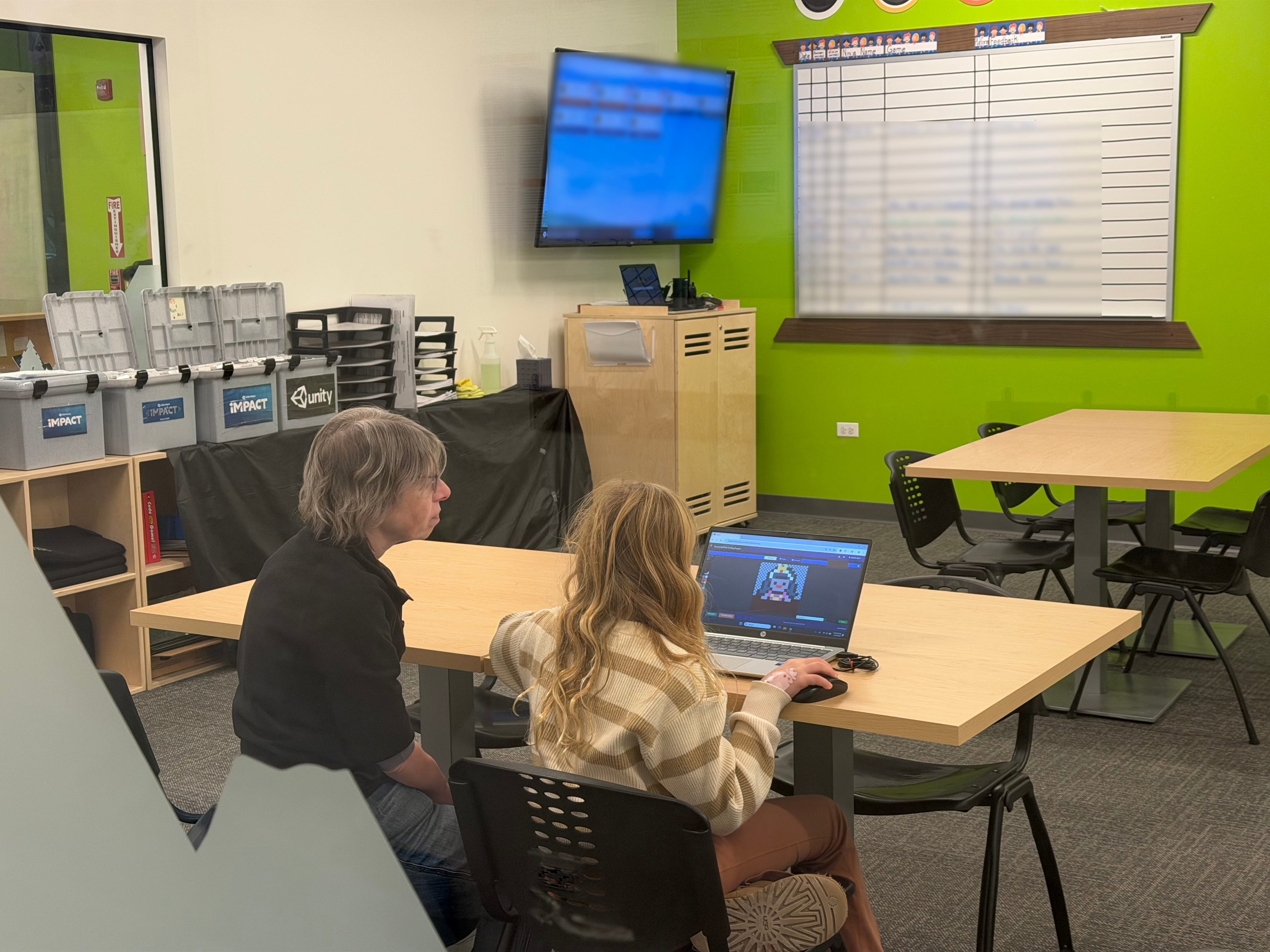
A few months back, she got that chance. Code Ninjas was interested in an interview, and I asked if it was okay if my daughter sat in on a few lessons, while I observed.
The basic pitch of Code Ninjas, as Kim put it, is obviously attractive to a child: “to ignite [their] passion for learning how to code and create through video games.”
That pitch immediately landed on my kid, too, who spent a few weeks working one-on-one with an instructor to draw pixel art for her medieval fantasy game, learn some basic theory about code, and came away interested in revisiting the experience when she’s a little older. She’s crafty at heart, so Code Ninjas spoke to her primary interests.
“Our pedagogy comes from Mitchel Resnick, who wrote a book called Lifelong Kindergartner,” said Kim, “and we also follow Seymour Papert, who created constructionism out of MIT, in terms of education philosophy. The whole idea is that we’re forever kids, and the best way to learn is to play, to find a medium that we enjoy. To learn through that medium is the best way to learn.”
Prior to Code Ninjas, Kim spent more than a decade at the college prep company C2 Education, where he rose in the ranks from a mere tutor to becoming an executive.
Whatever the impact of AI on the job market, coaxing children into learning through games makes sense. There’s so much cross disciplinary creativity in video games, and it provides an opportunity for you to see it one, or more, speaks to you. Maybe you’re not going to become a concept artist, but hey, you can still put some pixels together.
(That was, far and away, my daughter’s favorite part. The coding theory was fine, but it was an obstacle to be defeated in pursuit of being able to go back to crafting pixel art.)
Children at Code Ninjas work their way up, over time, to independence.
“The students you see coming in either started off as very independent learners and their parents told us as such, or they became confident, comfortable in our classrooms,” said Kim.
“The whole idea is that we’re forever kids, and the best way to learn is to play, to find a medium that we enjoy. To learn through that medium is the best way to learn.”
At the start, students use what’s called “block-based code”—aka, visual-based coding to convey the concepts of writing actual code—before they move onto JavaScript, then later C#, at which point they’ll even become familiar with common tools like Unity.
My daughter likes working with teachers. She dropped an art class because, in her words, “they told us to draw something and then played on their phone.” In the classes I observed, it was a mixture of kids working one-on-one, following along with an instructor as part of a group, or if the kids were older (think teenager), on their own.
I mean mostly as compliment: Code Ninjas has a daycare vibe. Any aftercare program is going to cost you a ton, and in many cases, it might just be adults hanging around, making sure everyone is staying safe. Building a video game isn’t a bad alternative.
“Sometimes locations have an aftercare option to add to your cart when you enroll with us,” said Kim, “because they know it’s all nine-to-six-o-clock working parents and they need three hours of babysitting and they’re like ‘Hey, at least make it productive.’ Absolutely we get that.”
That vibe could be different at different Code Ninjas locations, though; it’s a franchise model, which means anyone can apply to build and run a Code Ninjas, much like a fast food restaurant. If someone’s interested in opening a Code Ninjas, they can apply right on the website and start a conversation with the company. Kim, who has been with Code Ninjas for almost three years, admits the process used to be a little fast.
“For the new owners, it used to be just training around sales and the point of sale system,” said Kim. “It didn’t really go into the pedagogy, the marketing practices, the operational behaviors, any of that other stuff that you need to build a successful business. That’s why we have a whole week now.”
The reviews for locations in our area—there are a handful—are generally positive.
When it comes to instructors, there is a training program, but Kim said Code Ninjas emphasizes less technical expertise and more “How good they are with kids?”
“Are they making them smile?” he said. “Are they teaching them effectively? Some of our best teachers are actually summer camp counselors across the country.”
Alongside that, Code Ninjas now has summer camps, clubs, and other ways for children to find their way in the building. A description like that might conjure an image of a business that’s overflowing with children coming in and out—and perhaps some locations do have that. In our case, it was much more chill. Fewer kids. A handful of children swapping out for another handful on a random weekday evening.
(My kid was usually swinging by after an early dinner. The location closed at 7:00 p.m.)
It does not appear we’re about to become a Code Ninjas family, but I’m not ruling it out. Plus, we’re gearing up for my five-year-old to have swim lessons again, which means we’ll be walking near a Code Ninjas. I’ll have to see what my daughter says.
Have a story idea? Want to share a tip? Got a funny parenting story? Drop Patrick an email.
Also:
If you have experience with Code Ninjas, would love to hear about them in the comments. I suspect experiences could vary wildly between different locations.
If you have suggestions for alternatives to Code Ninjas, also drop this in comments. My kid has asked about ways she can “make her own app or game.”
I can recommend ScratchJr and Scratch which my 9 year old has been using through school (it’s part of the UK curriculum). She really enjoys it to make puppet shows and mazes, but don’t know yet if she’ll want to graduate from the block logic to using a full language like Python or JavaScript.
Second the recommendation for Scratch for any kid that wants to do coding at home (it’s also been part of our kids’ curriculum in NYC). One of our kids is heavily into coding. We did a week or two at a Code Ninjas in Brooklyn for summer camp, but he’s really been enjoying Penguin Coding, another local option, which he’s found to be more advanced for him. Highly recommend them if you happen to live in Brooklyn or Massachusetts!